
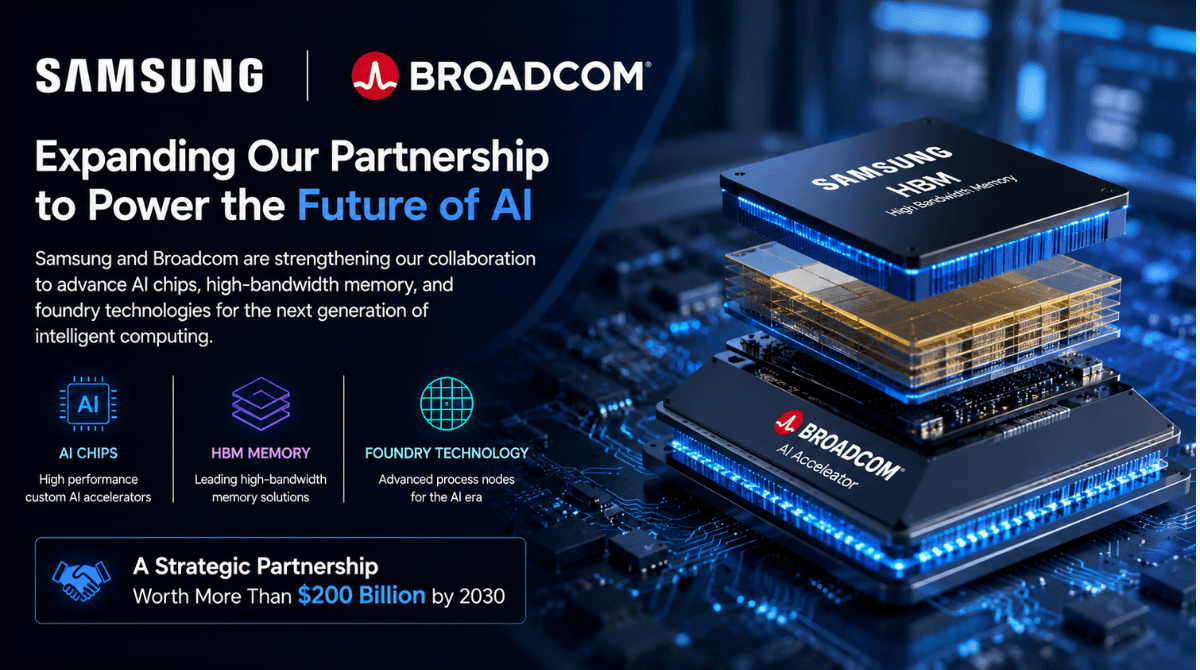
The Samsung and Broadcom AI chip partnership is a deal in the semiconductor industry in 2026. Samsung Electronics and Broadcom are working together to make AI chips, high-performance memory and next-generation chip manufacturing technologies. This partnership is expected to be worth than $200 billion by 2030. This is because more and more companies are using intelligence.
For India this is not news about companies in other countries. India is investing a lot in AI, cloud computing and digital transformation. If companies like Samsung and Broadcom work together it could mean that India gets access to advanced AI hardware. This could also encourage companies to invest in Indias technology industry.
What Is the Samsung and Broadcom AI Chip Partnership?
Samsung Electronics and Broadcom have signed an agreement to work together on building the generation of AI infrastructure.
The partnership is three main things:
- High Bandwidth Memory
- Advanced semiconductor manufacturing
- Advanced chip packaging technologies
The companies think this partnership could be worth more than $200 billion over the next five years.
Why Is This Partnership Important?
Artificial Intelligence needs a lot of computing power.
Modern AI applications like:
- Large Language Models
- AI assistants
- vehicles
- Medical AI
- Robotics
- Smart manufacturing
all need AI chips.
Broadcom designs custom AI processors and Samsung makes semiconductors.
Together they want to make more energy-efficient AI hardware.
Key Technologies Behind the Collaboration
High Bandwidth Memory
High Bandwidth Memory is important for AI computing.
It is better than memory because it:
- Moves data faster
- Uses power
- Works better for AI training
- Is more efficient for data centers
Samsung will provide High Bandwidth Memory solutions for Broadcoms AI accelerators.
Advanced Foundry Technology
Samsung will make Broadcom chips using its 2-nanometer process technology.
Smaller semiconductor nodes mean:
- Faster processors
- electricity consumption
- Better thermal performance
- Transistors
This helps AI chips work better while using less power.
Advanced Packaging
Modern AI chips are complex.
Of putting everything on one chip manufacturers combine multiple chips using advanced packaging.
Samsungs technologies include:
- 2.3D Integration
- 2.5D Packaging
These methods improve:
- Communication between chips
- AI processing speed
- Overall system efficiency
Why Broadcom Chose Samsung
Broadcom is a leading custom AI chip designer.
The company needed a manufacturing partner that could:
- Make AI chips
- Produce large quantities
- Support AI demand
- Integrate memory and packaging
Samsung offers all these services.
This reduces complexity. Improves production efficiency.
TRYE THIS: CGPA Calculator
How This Benefits India
Although the agreement is between companies in South Korea and the US India could benefit in ways.
1. Stronger AI Infrastructure
India is growing its:
- AI startups
- Data centers
- Cloud services
- Government AI projects
Better AI chip production can help meet demand.
2. More Investment in Semiconductor Ecosystem
India has started semiconductor initiatives.
Global partnerships can encourage:
- New investments
- Manufacturing collaborations
- Technology transfer
- Supply chain expansion
3. Better AI Services
Companies using AI could get:
- Cloud computing
- More affordable AI infrastructure
- Enterprise AI solutions
4. Opportunities for Indian Engineers
Growing demand for AI hardware creates opportunities in:
- Chip design
- Embedded systems
- AI software
- Hardware validation
- Semiconductor manufacturing
Impact on the Global AI Industry
The AI industry is moving towards designed processors.
Companies want chips that are optimized for their workloads.
The Samsung-Broadcom collaboration supports this trend by combining:
- Custom AI chip design
- manufacturing
- High-speed memory
- Efficient packaging
Industry analysts think demand for AI chips will keep growing rapidly.
READ MORE : Airtel Payments Bank IFSC Code: Complete Guide for 2026
Challenges
Despite the positive outlook there are challenges.
Manufacturing Competition
Samsung competes with major semiconductor manufacturers.
Winning long-term AI customers is crucial.
Supply Chain Risks
The semiconductor industry faces challenges like:
- Material shortages
- Rising manufacturing costs
- Geopolitical tensions
Diversifying production is important.
Rising AI Demand
AI demand is increasing faster than manufacturing capacity.
Meeting requirements will need:
- More factories
- packaging technologies
- Larger memory production
Practical Takeaways for Businesses
Businesses planning to use AI should monitor semiconductor developments.
Chip availability affects AI costs.
Consider these steps:
- Follow AI hardware trends.
- Plan cloud infrastructure carefully.
- Optimize AI workloads.
- Budget for changing hardware prices.
- Stay informed about semiconductor partnerships.
TRYE THIS: Attendance Calculator
Examples of Real-World Impact
Imagine a healthcare startup training medical AI models.
With AI hardware:
- Training becomes faster.
- Energy consumption decreases.
- Cloud computing costs may become more predictable.
- AI services can scale efficiently.
Fintech companies, manufacturers and educational technology platforms could also benefit from AI infrastructure.
Asked Questions (FAQs)
What is the Samsung and Broadcom AI chip partnership?
It is a collaboration covering AI memory, semiconductor manufacturing and advanced packaging technologies worth than $200 billion by 2030.
Why is High Bandwidth Memory important?
High Bandwidth Memory helps AI processors move data faster while using power.
How does this partnership affect India?
India could benefit through improved AI infrastructure, semiconductor investments, technology collaboration and new career opportunities.
What industries benefit the most?
Industries, like healthcare, finance, manufacturing, cloud computing, education, autonomous systems and enterprise AI are expected to benefit.
Will this reduce AI hardware costs?
Not but increased production capacity and long-term supply agreements could help improve chip availability over time.